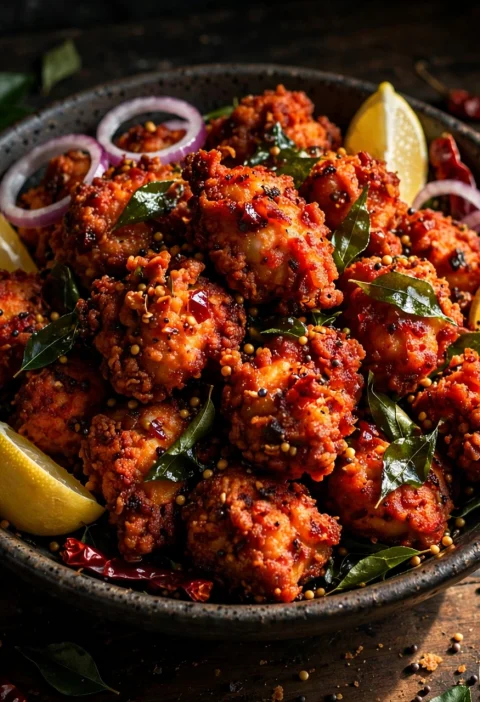
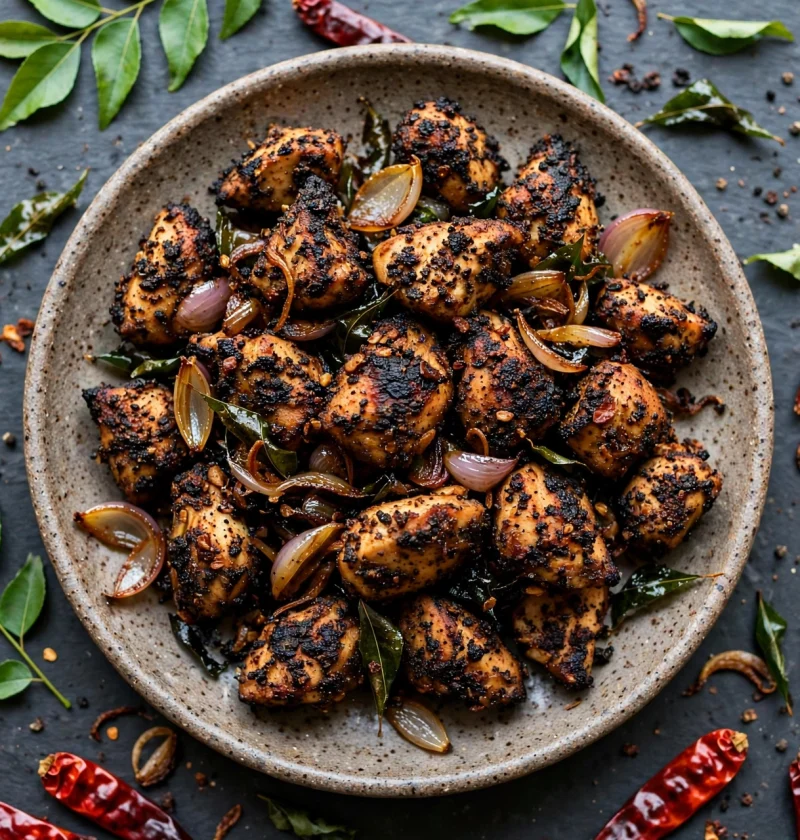
If you love chicken that hits back — crackling spice crust, peppery heat, and the unmistakable aroma of curry leaves tempered in coconut oil — this chicken varuval is your dish. Varuval means “dry fry” in Tamil, and that’s exactly what this classic of Tamil cuisine is: chicken tossed and dry-roasted in a freshly ground pepper-and-fennel masala until every piece wears a dark, fragrant spice coat. No gravy, no shortcuts — just bone-deep South Indian flavor, the way it’s served at roadside shops and home tables across Tamil Nadu.
Why You’ll Love This Chicken Varuval
- Bold, dry-roast flavor — not a curry at all: caramelized shallots, crushed black pepper and curry leaves cling to every bite.
- Freshly ground masala — whole spices ground at home give a punch that pre-ground pepper simply can’t match.
- Naturally gluten-free and dairy-free — coconut oil does all the richness work.
- Weeknight friendly — 20 minutes of prep, one kadai, and 50 minutes start to finish.
- Party-perfect starter — serve it on a banana leaf with lemon wedges and watch it disappear.
Chicken Varuval Ingredients
For the Chicken & Marinade
- 1½ lbs (700g) bone-in chicken pieces (drumettes and thighs), skin removed — or boneless thighs cut into 1½-inch chunks
- 1 tablespoon ginger garlic paste
- 1 teaspoon turmeric powder
- 1 teaspoon Kashmiri red chili powder
- 1 tablespoon lemon juice
- 1 teaspoon salt (for the marinade)
For the Varuval Masala (Freshly Ground)
- 2 tablespoons whole black peppercorns
- 1 tablespoon fennel seeds
- 1 teaspoon cumin seeds
- 4–5 dried red chilies (Byadgi or Guntur; remove seeds for less heat)
- 1 teaspoon coriander seeds (optional, adds a toasted base note)
For the Fry & Finish
- 4 tablespoons coconut oil, divided
- 2 cups (about 10–12) small shallots or pearl onions, peeled and halved
- 3 sprigs fresh curry leaves (about 30 leaves)
- 1 teaspoon mustard seeds
- ½ teaspoon salt (for the fry), or to taste
- Lemon wedges, for serving
How to Make Chicken Varuval
Step 1: Marinate the Chicken
In a large bowl, toss the chicken pieces with the ginger garlic paste, turmeric, Kashmiri red chili powder, lemon juice, and salt until evenly coated. Cover and refrigerate for at least 30 minutes, or up to 4 hours — this is what lets the flavor go past the surface.
Step 2: Dry-Roast and Grind the Spices
Heat a dry skillet over medium heat. Add the black peppercorns, fennel seeds, cumin seeds, coriander seeds (if using), and dried red chilies. Toast for 2–3 minutes, shaking the pan, until the spices darken a shade and smell intensely aromatic — don’t let them smoke. Cool for 2 minutes, then grind to a coarse powder in a spice grinder. Coarse is important: this is a crust, not a powder.
Step 3: Temper in Coconut Oil
Heat 3 tablespoons of coconut oil in a wide, heavy kadai or skillet over medium-high heat. When the oil shimmers, add the mustard seeds and let them pop for 20–30 seconds. Add the halved shallots and 2 sprigs of curry leaves. Sauté for 8–10 minutes, stirring often, until the shallots turn deep golden and start to crisp at the edges.
Step 4: Add the Chicken and Masala
Add the marinated chicken to the kadai and toss to coat in the shallot-curry leaf mixture. Sprinkle over all of the freshly ground varuval masala. Cook over medium-high heat for 5 minutes, turning the pieces, until the chicken sears and the masala toasts into a dark, fragrant coating. Lower the heat, cover, and cook for 15–18 minutes, stirring every 5 minutes, until the chicken is cooked through (165°F / 74°C internal temperature) and the moisture has dried out — varuval should be dry, never saucy.
Step 5: The Dry-Fry Finish
Uncover, raise the heat to high, and drizzle over the remaining 1 tablespoon of coconut oil. Toss in the remaining sprig of curry leaves. Dry-fry for 4–5 minutes, tossing constantly, until the chicken pieces develop charred, crispy edges and the whole kadai smells of toasted pepper and curry leaves. Taste and adjust salt — the masala should coat, not pool.
Step 6: Serve
Transfer to a warm platter, squeeze lemon wedges over the top, and serve immediately while the spice crust is still crackling.
Tips for the Best Chicken Varuval
- Grind the spices coarse. A fine powder disappears into the fry; a coarse grind gives you the signature peppery crust that makes varuval, varuval.
- Don’t rush the shallots. Golden, jammy, nearly-crisp shallots are the sweet counterpoint to all that pepper — 8–10 minutes minimum.
- Bone-in wins. Drumettes and thighs keep the meat juicy through the dry-roast; boneless works but watch it closely in Step 4.
- Coconut oil, not a substitute. The finish of fresh coconut oil is the soul of the dish — vegetable oil changes the entire flavor.
- Control the heat honestly. Guntur chilies are fierce; Byadgi or Kashmiri chilies give color and warmth. Remove the seeds and halved the dried chilies if your family likes it milder.
What to Serve with Chicken Varuval
Chicken varuval is a star starter, but it also makes a fantastic main. Serve it with steamed basmati or parboiled rice and a bowl of rasam or sambar to round it out, or keep it street-style on a banana leaf with lemon wedges and a simple cucumber salad. It also pairs beautifully with curd rice — the cool curd is the perfect foil for the pepper heat. For a fuller Tamil-style meal, add some drumstick sambar and a crispy papad.
Storage and Reheating
- Refrigerator: Store in an airtight container for up to 3 days. The pepper masala flavor deepens nicely overnight.
- Freezer: Freezes well for up to 2 months. Thaw overnight in the fridge before reheating.
- Reheating: Warm in a dry skillet or kadai over medium heat for 5–6 minutes, tossing, until heated through and the coating crisps up again. Avoid the microwave — it steams the chicken and softens the crust.
Chicken Varuval FAQs
Is chicken varuval the same as Chettinad chicken?
Not quite. Both are Tamil dishes, but Chettinad chicken is typically a gravy-style curry with coconut and roasted coconut masala, while varuval is a dry fry — the chicken is coated in a pepper-fennel spice crust with no gravy at all.
Can I make chicken varuval less spicy?
Yes. Halve the black peppercorns and use mild dried red chilies (Byadgi or Kashmiri), seeded. You’ll still get the full curry-leaf and fennel flavor, just with less fire.
Can I use chicken breast instead of bone-in pieces?
You can, but cut the pieces a little larger and reduce the covered cooking time in Step 4 to 10–12 minutes — breast dries out fast in a dry fry. Thighs are the safest bet.
What does “varuval” mean?
Varuval is a Tamil word meaning “dry fry” — it describes dishes where meat is roasted in spices with very little or no liquid, so the masala forms a dry coating.
Why is my varuval soggy instead of dry?
Two usual culprits: too many chicken pieces crowded in the pan (steam builds up — cook in batches), or skipping the high-heat uncovered finish in Step 5. That final dry-fry is what drives off the last moisture and crisps the spice crust.
Chicken Varuval (Tamil Nadu Dry Fry)
Ingredients
Method
- Marinate the Chicken: In a large bowl, toss the chicken pieces with the ginger garlic paste, turmeric, Kashmiri red chili powder, lemon juice, and salt until evenly coated. Cover and refrigerate for at least 30 minutes, or up to 4 hours.
- Dry-Roast and Grind the Spices: Heat a dry skillet over medium heat. Add the black peppercorns, fennel seeds, cumin seeds, coriander seeds (if using), and dried red chilies. Toast for 2–3 minutes until aromatic. Cool for 2 minutes, then grind to a coarse powder.
- Temper in Coconut Oil: Heat 3 tablespoons of coconut oil in a wide, heavy kadai over medium-high heat. Add the mustard seeds and let them pop for 20–30 seconds. Add the halved shallots and 2 sprigs of curry leaves. Sauté for 8–10 minutes until deep golden.
- Add the Chicken and Masala: Add the marinated chicken to the kadai and toss to coat. Sprinkle over all of the freshly ground varuval masala. Cook over medium-high heat for 5 minutes, then lower heat, cover, and cook for 15–18 minutes until cooked through (165°F / 74°C) and moisture has dried out.
- The Dry-Fry Finish: Uncover, raise heat to high, drizzle over the remaining 1 tablespoon of coconut oil. Toss in the remaining sprig of curry leaves. Dry-fry for 4–5 minutes until charred, crispy edges develop.
- Serve: Transfer to a warm platter, squeeze lemon wedges over the top, and serve immediately while the spice crust is still crackling.